
So, you’re ready to apply for Canadian PR! But there are plenty of ways to make avoidable mistakes that could cost you the application and potentially your chance to get permanent resident status. Let’s look at some of the more common mistakes I’ve seen in permanent residence applications, so you can avoid them.
The Most Common Errors in Canadian PR Applications:

Not disclosing ALL required information
It may be that you failed to mention it because you didn’t think it was important, or you simply forgot. But this is one of the most critical errors you can make in an application for Canadian PR, because failure to disclose required information can potentially lead to a charge of misrepresentation and a five-year ban from immigrating to Canada.
Examples of information I have seen clients fail to disclose which later caused problems in their application for Permanent Residence include:
- All work history for the last 10 years or since the age of 18 – including freelance or self-employed work, overlapping work (two or more jobs done at the same time), work done while studying, and volunteer work. All of these things must be disclosed in an application for Canadian PR.
- Previous (or current) common-law partners. A common-law partner is a conjugal partner who you have lived with continuously for at least one year. Canada recognizes common-law partners in addition to spouses, and these partners must be disclosed in an application – even if the concept of “common-law partner” does not exist in your home country.
- Other names used, either currently or previously. IRCC requires you to disclose any name you have used, whether this was a legal name or not. And yes, this does include “nicknames”. This may seem like a minor detail, but I’ve seen this become a problem first-hand several times. When in doubt, disclose it.
Submitting incorrect documentation
IRCC requires very specific documentation to be included with each application package. What exactly is required will depend on your situation, but here are a few common mistakes I’ve seen over the years:

- Photos: pay attention to what IRCC requires from your photo – especially what you must write on the back (if anything). When applying for Canadian PR, photos must meet certain requirements in dimension and resolution, and there is often information that must be written on the back of the photo. If the photo is not up to specification or the required information is not written on the back, the whole application for Canadian PR could be rejected. This applies not only to digital but also hard copy paper photos.
- Police certificates: most of the time, IRCC requires police certificates from countries lived in for six or more months since 18 years old. While this may seem straightforward, there are small nuances to be careful to follow. For example, several countries have “special considerations” that may apply to your situation, such as additional document requirements like a driving record or notarized translation. Also pay attention to the validity of your certificate; there are situations where the certificate may not be considered “valid” by IRCC anymore, even if the certificate itself has a validity date that has not been reached yet!
- Marriage certificate: relating to spousal sponsorship, a marriage license is not a marriage certificate. I’ve unfortunately seen numerous cases of applicants having their spousal sponsorship applications rejected because they submitted a marriage license instead of a certificate, thinking these were interchangeable. They are not, and if you are married then you must submit the marriage certificate.
Submitting outdated, stale-dated, or incorrectly signed forms
In the age of digital applications, this is becoming less of an issue than it was pre-Covid times when paper-based applications were the norm. But for many cases, some forms must still be signed directly and submitted with the rest of your application. There are three things to pay attention to when submitting an application for Canadian PR to IRCC in relation to the forms you submit:

- The version of the form: if you are required to submit an IMM form with your application, pay attention to the version and date of the form in the bottom-left corner of the page. You must use the most recent version of the form available online from IRCC, and failing to do so could cause your application for Canadian PR to be rejected.
- The date you sign the form: forms are considered “stale-dated” when the date of signing is 90 days or earlier at the time when IRCC receives the application. An application for Canadian PR with stale-dated forms will be returned by IRCC and will not be processed. Similarly, forms cannot be signed “in advance” with a future date, and IRCC will likewise reject an application if the form is dated at a future date.
- The way the form is signed: yes, how you sign the form is important. For some forms, in particular for family sponsorship applications, signatures are required in a very specific format. And confusingly, this format is not the same across all the forms. For example, the form may need to be signed “digitally”, which means you have signed your form using software and with a stylus or computer mouse. Compare this to “handwritten”, which requires the form to be printed on paper, signed by hand, and then scanned.
Answering application form questions incorrectly or not completely
Did you know IRCC provides guidance on how to complete most IMM application forms step by step in their application package/forms download webpage? When applying for Canadian PR, it’s extremely common to come across a question here or there in a form that is confusing or seems ambiguous.
For example, one of the more common errors I have seen relates to whether the information of children of the principal applicant who are already Canadian citizens or permanent residents of Canada must be disclosed e.g. in the IMM 5406 form. Of course, the information of all children must be disclosed by the principal applicant, regardless of their immigration status in Canada. But the wording of the instructions is unclear to some who interpret that they do not need to be mentioned, with the justification that IRCC can check the information themselves.
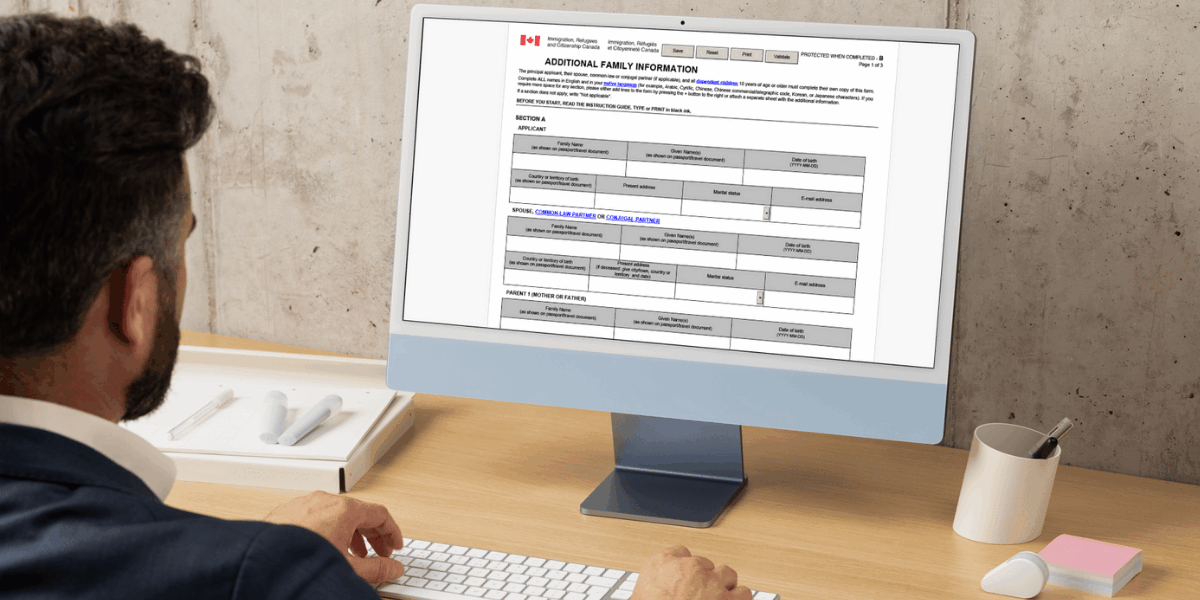
Another very common mistake, when applying for Canadian PR, is for applicants to not fully disclose some required information because they could not enter all of the information in IRCC’s provided application forms. This relates back to the first point above, but the reasoning behind not disclosing is different. Take for example the application form for a work permit. This form provides three spaces to enter your employment history for the last 10 years. But what if you’ve had more than three jobs in the last 10 years? Then you add extra pages of information as necessary until you’ve completed the full 10-year history.
This ensures that you are not omitting required information, and also avoids a charge of misrepresentation when applying for Canadian PR.
Read more about Express Entry here. If you are looking for more immigration or temporary programs in Canada, check our page under Services in Canada.
Conclusion
To summarize, it can be difficult to follow all of IRCC’s guidelines to the letter. So if you need help navigating all the small details of your application, feel free to reach out for a consultation if you are ready to apply or have any questions about applying for Canadian PR. Thanks, and until next time.
Learn more about Global Bridge in the following video.